
Modernize your
wholesale business
with an e-commerce
platform built for growth
Your needs are complex, but your commerce solution doesn’t have to be.




Accelerate your
digital
transformation
without losing
what’s already
working

Legacy solutions can’t compete with modern expectations, but building out an entirely new system feels daunting.
Intershop helps you launch digital capabilities quickly and stay competitive (without ripping and replacing your entire infrastructure).
Disconnected systems obscure customer behavior and limit insights and opportunities.
Composable commerce architecture connects systems, brings customer and product data together, and unifies your view of the business.
orders erode trust
Sales and distribution pipelines are split across online, phone, even fax orders.
Composable commerce supports multiple order structures and fulfilment options, while still presenting a clear, consolidated view to the customer.
Legacy websites and bulky catalogs are difficult to navigate, making it difficult to find and evaluate products.
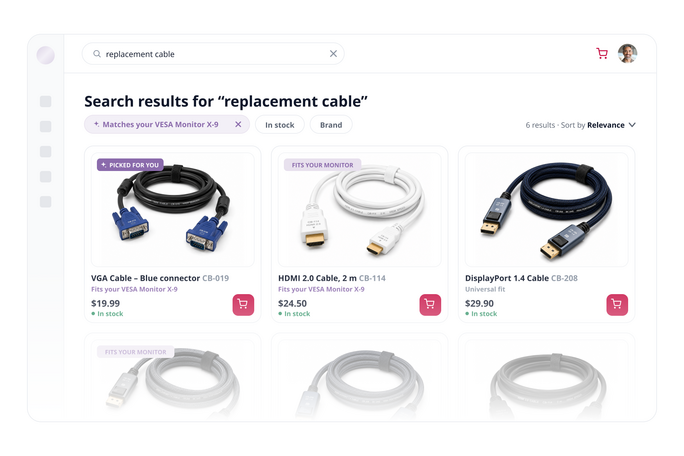
Improved search, navigation, and AI-backed assistance make it easier for customers to find exactly what they need.
Intershop’s composable commerce platform makes it easy to build solutions that match your businesses exact needs
Product discovery made easy
Customers should be able to find exactly what they need, no matter how technical:
- Powerful search and navigation, backed by API-first integrations across PIM, CRM, and more
- Recommendations and product identification assistance with AI copilot
- Enhanced personalization with product displays that match unique customer profiles
Build a digital
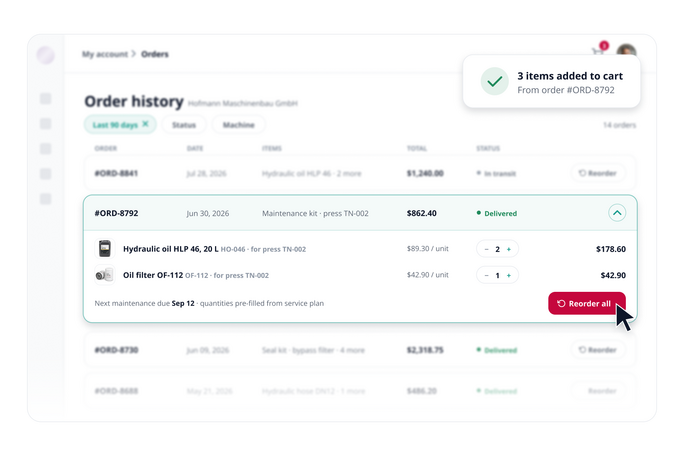
self-service experience
Self-service options help customers help themselves. They can:
- View order history and re-order quickly
- Schedule service appointments
- Order spare parts error-free
- Access service bulletins and tutorials
Reduce the pressure on your teams, and save their energy for interactions that make a difference.
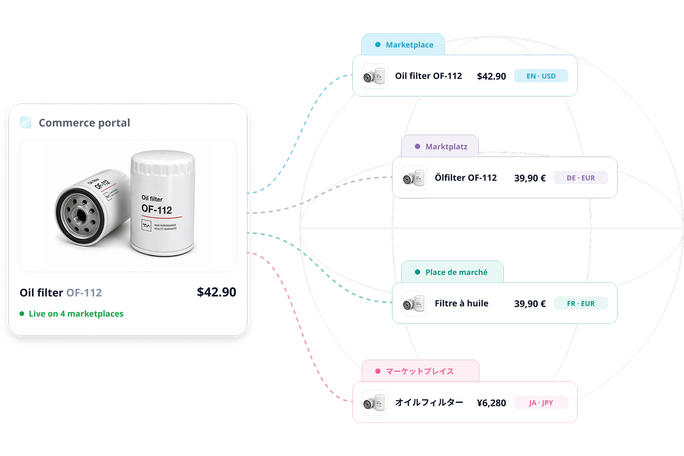
Help buyers discover your products
With Intershop, you can connect your business to established commerce channels and:
- Sync orders between buyers, marketplaces, and your own systems
- Create custom price lists, automate localization
- Enrich your offering with in-depth product and pricing information, and accurate stock numbers
How wholesale businesses are modernizing
their e-commerce with Intershop
Intershop offers deep customizability for wholesale businesses juggling customer needs, huge product catalogs, and complex sales processes.
Soennecken builds a
unified online webshop
The challenge:
When it came to bringing their business online, Soennecken needed to accommodate the needs of its 300+ distributors. They had to account for complex data structures as well as legal and localization requirements for different markets.
The solution:
A shopping experience built for both Soennecken members and their end customers:
- Merged three separate shop systems into one
- Full migration to composable architecture and strengthened digital presence
- AI-powered search, navigation and product discovery

Highline Warren leads industry with online shopping portal
The challenge: Highline Warren’s legacy e-commerce platform couldn’t scale to match customer expectations. Customers had a hard time finding and ordering products, requiring assistance with every purchase.
The solution: A fully integrated online shopping experience:
- Integrated self-service-driven ordering process
- Interactive 2D and 3D equipment models help customers identify and select the parts they need
- Desktop and mobile friendly


Resources

Learn how wholesalers build a competitive advantage with the right digital strategy.
Download whitepaper
Watch this video on how Würth made Intershop the core of their
e-commerce offering.

Discover how wholesalers successfully digitize their business model.
Get the whitepaperWholesale e-commerce - Frequently asked questions (FAQs)
A wholesale e-commerce platform is software built specifically for B2B sellers who sell in bulk to other businesses rather than individual consumers. It supports customer-specific pricing and negotiation, bulk ordering, order management, and integration with ERP and inventory systems — capabilities standard B2C platforms don't offer. This lets wholesalers automate ordering and fulfillment, cut manual errors, and reach buyers across digital channels.
Core requirements for a B2B wholesale commerce platform include custom pricing and discounts by customer segment, bulk ordering, real-time inventory integration, order management, a B2B customer portal for self-service, product information management for complex catalogs, flexible payment and invoicing, and marketplace connectivity. Increasingly, AI copilots for both buyers and merchants are becoming a standard layer on top of these — surfacing the right product or reorder automatically instead of requiring manual search.
E-commerce lets wholesalers deliver a consistent experience across every channel — web, phone, sales rep, app — while shifting routine, repetitive orders online. This frees sales and service staff for high-value, consultation-heavy accounts, lowers distribution and process costs, and removes media breaks between channels. Buyers increasingly prefer digital ordering for its speed and 24/7 availability, which shifts sales volume from manual to online channels without added headcount.
Wholesale e-commerce sells in bulk to businesses at negotiated, volume-based prices, with longer sales cycles, credit terms, and account-specific catalogs. B2C sells single units to consumers at fixed prices with immediate payment. Wholesale platforms need account hierarchies, minimum order quantities, and ERP integration — features a standard B2C storefront doesn't support.
As order volume grows and orders come in through multiple channels (web, EDI, phone, marketplaces), a dedicated OMS becomes essential. It centralizes order data, gives real-time inventory visibility across warehouses, and automates fulfillment routing — preventing overselling and inconsistent delivery promises that come from managing orders manually across systems.
Yes. Intershop Commerce Platform provides a broad set of standard B2B capabilities for wholesalers, including robust multi-organization management, customer-specific catalogs and pricing, account and user roles, quote-based purchasing, order templates, repeat ordering, self-service portals, and support for large product and order volumes. These capabilities can be extended through composable architecture, APIs and integrations when a wholesale business has industry-specific requirements.
Intershop Commerce Platform provides strong API integration capabilities for cloud wholesalers. It supports integration with key business systems such as ERP, PIM, CRM, pricing, inventory, order management, and other external services, making it well suited for complex B2B and wholesale environments. Its API-based and extensible architecture supports both standard integration scenarios and project-specific requirements in cloud-based commerce landscapes.
Integration bottlenecks mainly arise in two situations. First, the commerce platform sends too many synchronous requests to the ERP—for example, for real-time inventory or price checks. This can overload the ERP and slow down or interrupt the buying experience. Second, large volumes of product, customer, inventory and order data are exchanged regularly, especially during bulk synchronizations. Complex data transformations, tightly coupled interfaces, inconsistent data models and insufficient monitoring can make both situations worse.