Servitization in B2B and manufacturing
Servitization describes the shift from selling products only to offering integrated product-service solutions. For manufacturers and B2B companies, it enables recurring revenue, stronger customer relationships, and long-term value creation.
What is servitization?
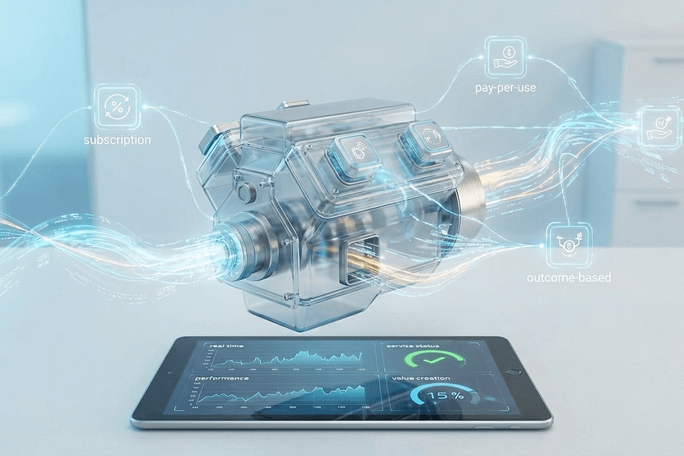
Servitization is a business strategy in which companies move beyond traditional product sales and offer services, solutions, or outcomes around their physical products. Instead of focusing solely on ownership, customers pay for usage, performance, or results – for example through subscriptions, pay-per-use, or outcome-based models.
In B2B and manufacturing industries, servitization is often enabled by digital technologies such as IoT, connected products, and e-commerce platforms. These technologies allow companies to manage complex service offerings, track product usage, and monetize aftermarket services across the entire product lifecycle.
For manufacturers, servitization creates new revenue streams, increases customer loyalty, and differentiates offerings in highly competitive markets.
Why is servitization important for manufacturers?
Servitization helps manufacturers stabilize revenue, move away from one-time sales, and build long-term customer relationships through recurring services and digital offerings.
Is servitization only about services?
No. Servitization combines products, services, software, and data into integrated solutions that deliver measurable value or outcomes to customers.
Key benefits of servitization for B2B and e-commerce companies
1. Recurring revenue streams
Subscription models, pay-per-use, and service contracts reduce dependency on one-time product sales.
2. Stronger customer relationships
Ongoing services increase touchpoints across the customer lifecycle and improve retention.
3. Differentiation in competitive markets
Service-based offerings are harder to copy than physical products alone.
4. Higher customer lifetime value
Aftermarket services, upgrades, and digital add-ons extend revenue beyond the initial sale.
5. Better use of data & insights
Connected products generate usage data that can be used to optimize services and predict customer needs.
Intershop highlights servitization as a key growth lever for manufacturers seeking to monetize digital services and manage complex B2B business models at scale.
Challenges and solutions of servitization
Challenge 1: Complex pricing models
Servitization requires flexible pricing such as subscriptions, pay-per-use, or outcome-based billing.
Solution: Modern B2B e-commerce platforms like Intershop support flexible pricing logic, contract-based pricing, and customer-specific agreements.
Challenge 2: Integration of products and services
The management of physical products and digital services in a single system is often fragmented.
Solution: Unified commerce platforms connect product catalogs, service offerings, and customer data across all channels.
Challenge 3: Scaling aftermarket services
Manual processes limit scalability and transparency.
Solution: Digital self-service portals enable customers to order services, spare parts, and upgrades independently.
Challenge 4: Data & usage tracking
Servitization depends on accurate usage and performance data.
Solution: Integration with IoT and ERP systems allows real-time data usage and automated billing models.
Intershop supports servitization strategies by enabling scalable, service-oriented B2B commerce architectures.
Use cases in B2B and manufacturing
Manufacturing: Equipment-as-a-service
Manufacturers offer machines bundled with maintenance, monitoring, and performance guarantees instead of selling equipment outright.
Industrial services: Pay-per-use models
Customers pay based on actual usage hours or output, reducing upfront investment.
Wholesale & engineering: Lifecycle services
Spare parts, maintenance contracts, and digital services are offered throughout the product lifecycle.
Intershop customer case
Huisman leverages servitization by combining complex industrial products with digital services and aftermarket offerings, supported by a scalable B2B commerce platform.


Technology & tools for implementing servitization
Servitization requires a digital foundation that connects products, services, customer data, and operational systems across the entire lifecycle. Key technologies include IoT sensors and connected devices to capture real-time usage data, cloud platforms to scale digital services globally, and AI-driven analytics to predict maintenance needs, optimize service delivery, and enable outcome-based business models.
A successful servitization strategy also depends on a strong B2B e-commerce platform that can manage service catalogs, subscription models, pay-per-use pricing, and customer-specific contracts. In many manufacturing environments, this must be supported by integrations with ERP, CRM, and field service systems to ensure accurate pricing, billing, and service fulfillment.
Intershop provides a composable commerce architecture with scalable APIs and integration capabilities, enabling manufacturers to unify product and service offerings in one digital ecosystem. This allows companies to build customer self-service portals, monetize aftermarket services, and expand service-driven business models across regions and channels.
FAQs
What is the main goal of servitization?
The main goal of servitization is to create long-term value by combining products with services and digital solutions. It enables recurring revenue, stronger customer relationships, and differentiation beyond physical products.
What industries benefit most from servitization?
Servitization is especially valuable for manufacturing, industrial equipment, engineering, and wholesale industries where complex products, long lifecycles, and aftermarket services play a key role.
What is the servitization of manufacturing?
Servitization of manufacturing refers to the shift from selling physical products only to offering integrated product-service bundles. Manufacturers combine equipment with services such as maintenance, monitoring, upgrades, or performance-based contracts to deliver continuous value over the product lifecycle.
Why is servitization important for manufacturers?
Servitization helps manufacturers generate recurring revenue, reduce dependency on cyclical product sales, and build long-term customer relationships. It also enables differentiation in competitive markets by focusing on outcomes rather than products alone.
What are examples of servitization?
Common examples of servitization include equipment-as-a-service, pay-per-use models, predictive maintenance services, digital spare parts catalogs, and lifecycle service contracts that bundle products with ongoing support.
Is servitization suitable for B2B e-commerce?
Yes. Servitization is highly suitable for B2B e-commerce because digital platforms enable complex pricing models, subscriptions, service catalogs, and customer-specific contracts, all accessible through scalable self-service portals.
What technology is needed for servitization?
Servitization requires a combination of B2B e-commerce platforms, IoT and connected products, subscription and billing systems, ERP and CRM integrations, and data analytics tools to manage services, usage data, and customer relationships effectively.

Ready to implement servitization?
Discover how Intershop helps manufacturers and B2B companies build scalable, service-driven business models.