Aftermarket in B2B e-commerce
In many B2B industries, the aftermarket has become a decisive competitive factor. It shapes how manufacturers and wholesalers generate recurring revenue, deliver value beyond the initial sale, and build long-term customer relationships through digital services and spare parts commerce.
What is aftermarket?
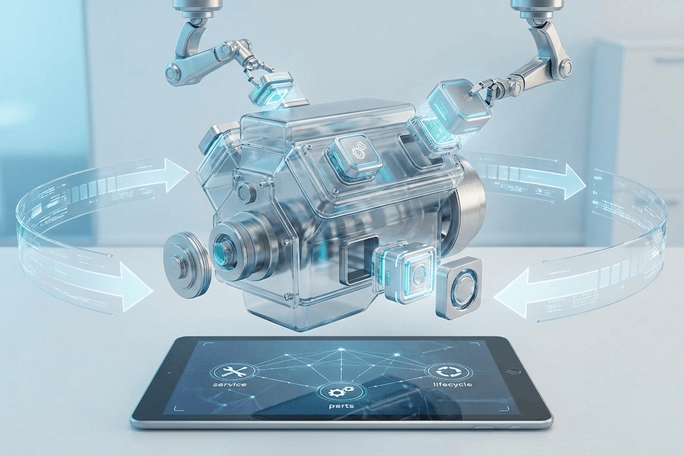
The aftermarket refers to all products, services, and spare parts sold after the initial sale of a primary product. In B2B industries such as manufacturing and wholesale, the aftermarket is a critical revenue driver, covering spare parts, maintenance services, upgrades, and digital services throughout the product lifecycle. Unlike the primary market, aftermarket transactions focus on long-term customer relationships, repeat purchases, and service excellence.
Due to these characteristics, the aftermarket is developing into a stable, long-term, predictable business model in many industries – even in economically challenging times.
Why is the aftermarket important for B2B companies?
The aftermarket is important for B2B companies because it generates recurring revenue, increases customer lifetime value, and strengthens long-term relationships through spare parts, services, and digital self-service offerings.
What is the difference between primary market and aftermarket?
The primary market focuses on the initial sale of a product, while the aftermarket covers all spare parts, services, and upgrades sold after the original purchase throughout the product’s lifecycle.
Benefits of aftermarket e-commerce
1. Stable and recurring revenue streams
Aftermarket sales enable predictable, recurring revenue through repeat purchases of spare parts, maintenance services, and upgrades over the entire product lifecycle.
2. Strong customer retention
By supporting customers after the initial sale, the aftermarket strengthens long-term relationships and increases loyalty through continuous service and availability.
3. Higher margins compared to initial equipment sales
Spare parts and aftermarket services often deliver higher profit margins than primary product sales, as they are less price-sensitive and more demand-driven.
4. Opportunities for personalization and digital self-service
Digital aftermarket platforms allow companies to personalize catalogs, pricing, and recommendations while enabling customers to self-serve efficiently through online portals.
Personalization in the aftermarket
Personalization in the aftermarket focuses on efficiency, accuracy, and relevance rather than impulse-driven sales. B2B buyers expect relevant search results, fewer clicks, and fast access to the correct spare parts without information overload.
Unlike B2C personalization, which often aims to increase basket size, B2B personalization must support structured procurement processes. In the aftermarket, this includes personalized catalogs, contract-specific pricing, role-based access to information, bulk ordering capabilities, and approval workflows.
Effective aftermarket personalization relies on high-quality product, customer, and installed base data. By using this information, companies can ensure spare part compatibility, reflect machine-specific configurations, and significantly reduce ordering errors while improving the overall customer experience.
Personalization strategies in the aftermarket
Modern B2B buyers expect the same speed, accuracy, and ease of use they know from B2C shopping experiences. In the aftermarket, personalization is not about impulse buying, but about helping customers quickly identify the correct spare part, reduce errors, and complete repeat purchases efficiently.
For OEMs and manufacturers, effective aftermarket personalization builds on standard B2B personalization strategies and extends them with aftermarket-specific capabilities:
Installed base-driven personalization
Knowing the customer’s installed base is the foundation of relevant spare parts commerce. It ensures that customers only see parts that fit their specific machines or configurations, significantly reducing search time and ordering errors.
Product and part relationship management
Maintaining the connection between spare parts and the equipment they belong to enables smoother repeat purchases and provides valuable insights for service teams and product development.
Version-specific spare part search
Aftermarket search must focus on identifying the exact product version or configuration. This ensures that only compatible spare parts and correct service information are presented.
Visual support for spare part selection
Visual aids such as 2D or 3D drawings, integrated with PLM systems, help customers accurately identify the required spare part and increase confidence during the ordering process.
Experience-based cross-selling and up-selling
Unlike B2C, aftermarket cross-selling should not rely on generic behavioral data. Instead, recommendations must be based on product expertise – for example, suggesting compatible accessories or wear parts likely to require replacement.
Legacy part and replacement management
Older spare parts are often replaced over time. A digital aftermarket platform must transparently manage part successors and alternatives to ensure continuity for long product lifecycles.
Maintenance and service content integration
Providing installation guides, documentation, and service instructions alongside spare parts helps customers complete maintenance tasks faster and improves overall service efficiency.
Unified digital aftermarket experience
A single digital interface should support the entire aftermarket journey – from spare part ordering and service booking to shipment tracking, invoicing, and returns.
To support these strategies, aftermarket platforms typically rely on capabilities such as advanced search, personalized catalogs and pricing, ERP and PLM integration, role-based user management, and real-time availability information.
In summary, a digital aftermarket portal that combines installed base intelligence, structured product data, and smart personalization improves customer experience, strengthens brand loyalty, and increases long-term aftermarket revenue.
Why is the aftermarket considered crisis-resistant?
The aftermarket is considered comparatively crisis-resistant in many B2B industries, as companies tend to focus more on maintenance, repairs, and spare parts in times of economic uncertainty rather than investing in new equipment or products. Recurring demand, longer product life cycles, and lower investment barriers on the customer side ensure more stable sales. In addition, aftermarket models allow for greater price and supply chain flexibility than the primary market.
Challenges & solutions
Challenge: Complex spare parts identification
In complex B2B environments, customers often struggle to identify the correct spare parts due to large assortments, product variants, and long equipment lifecycles.
Solution:
Personalized catalogs based on installed base data ensure that customers only see spare parts that fit their specific equipment and configuration. Digital commerce platforms such as Intershop enable this level of personalization by combining product data, customer context, and contract information in a single B2B storefront.
Challenge: Fragmented data
Aftermarket processes are often supported by disconnected systems for product data, customer data, and service information, leading to errors and inefficient ordering processes.
Solution:
Centralized data management combined with AI-powered search improves data consistency and makes relevant spare parts easy to find across all channels. With the Intershop Commerce Platform, companies can unify multiple data sources and provide a seamless aftermarket experience through a single digital platform.
Use cases for aftermarket
Manufacturers offering spare parts portals
OEMs (Original Equipment Manufacturers) provide personalized spare parts portals that allow customers to find compatible parts, access documentation, and manage repeat purchases efficiently.
Wholesalers managing complex catalogs
Wholesalers benefit from centralized catalogs, real-time availability, and personalized pricing to support complex B2B procurement processes across multiple customer segments.


Technology for the aftermarket
- AI-powered and intuitive search for fast spare part identification
- Installed base management to ensure compatibility and relevance
- Personalized catalogs and contract pricing
- Visual support such as 2D or 3D drawings for accurate part selection
- ERP and PLM integration for synchronized data and inventory
- B2B customer portals enabling ordering, service booking, documentation access, and returns
FAQs
Is the aftermarket limited to spare parts only?
No, the aftermarket includes spare parts, maintenance services, repairs, upgrades, software, and digital services provided after the initial product sale.
How does the aftermarket contribute to long-term customer value?
The aftermarket increases customer lifetime value by supporting ongoing needs throughout the product lifecycle and enabling repeat purchases, service contracts, and long-term engagement.
What role does digitalization play in the aftermarket?
Digitalization enables efficient aftermarket processes through online portals, personalized catalogs, automated ordering, and self-service capabilities for B2B customers.
Why is personalization critical in the aftermarket business?
Personalization ensures that customers see only relevant spare parts, prices, and services based on their equipment, contracts, and usage, reducing errors and improving ordering efficiency.
Which industries benefit most from a digital aftermarket strategy?
Industries with complex products and long lifecycles – such as manufacturing, industrial equipment, and wholesale – benefit most from digital aftermarket platforms.

Ready to scale your aftermarket digital?
Let’s optimize your aftermarket strategy with personalized catalogs, smart self-service, and recurring revenue growth.