
Agentic commerce
Agentic commerce is the next evolution in digital B2B commerce. AI-powered software agents autonomously perform tasks and, make decisions, unlocking new levels of efficiency, personalization, and adaptability in commerce processes. Through agentic commerce, enterprises can scale faster and secure a lasting competitive edge.
What is agentic commerce?
Agentic commerce refers to the use of intelligent software agents that independently execute tasks within commerce processes. Unlike traditional automation, these agents are context-aware, adaptive, and make decisions independently based on data and AI. They can optimize product data, generate offers, or trigger orders – often fully autonomously.

How is agentic commerce different from classic automation?
Agentic Commerce relies on adaptive AI, agents that learn and act contextually – not just follow fixed, rigid rules. They interact with people, systems, and data sources to make optimal decisions.
How do B2B companies benefit from agentic commerce?
B2B companies gain speed, scalability, and service quality. Tasks are automated, processes become more efficient, and new business models can be tested faster.
What are the benefits of agentic commerce?
1. 24/7 automation
Agents handle repetitive tasks around the clock – without fatigue or errors. This allows companies to process orders, update inventory, or respond to customer inquiries at any time, significantly increasing operational efficiency and freeing up staff for higher-value tasks.
2. Faster time-to-market
With agentic commerce, companies can quickly roll out new services or business models, or enter regional markets. AI agents automate processes such as storefront localization, onboarding, catalog updates, and campaign launches, reducing the cost and effort of initial tests and eliminating the need to stand up a dedicated team before a market is proven.
3. Better use of existing data
Agents can process and interpret data at a much faster rate than any human, making it suddenly possible to glean real insights from vast and disparate sources of data. These insights can support decision-making, improve campaign targeting, and even provide the basis for new service offerings.
4. Personalization & service
Customers receive tailored recommendations and proactive support, and relevant content at every touchpoint. By leveraging real-time data, employees can respond much more precisely to individual needs, thereby increasing satisfaction and loyalty – whether it's configuring complex B2B solutions or making maintenance suggestions in the after-sales area.
5. Competitive edge
Mid-sized businesses compete on par with large enterprises. Automated workflows and intelligent decision-making enable businesses to scale flexibly and respond more quickly to market changes, turning agility into a strategic advantage.

“For me, agentic commerce is about letting AI agents take real responsibility in commerce. They handle tasks from start to finish, making selling quicker, service better, and buying easier for everyone involved.”
Opportunities & challenges of agentic commerce
Implementing agent-based processes in digital commerce opens up a wide range of opportunities for companies. It also requires new ways of thinking, clear responsibilities, and careful risk assessment. Agentic commerce is not just a technology project – it’s a strategic decision that affects the organization, processes, and roles.
Opportunities
Scalability and efficiency:
Agents can work 24/7, perform tasks in parallel, and adapt quickly to changes. Companies who use agents can save time, reduce errors, and respond more quickly to dynamic market conditions.
Personalization and improved service:
Specialized agents create new opportunities for tailored advice, targeted recommendations, and a higher level of service without requiring proportionally more staff.
Data-driven decisions:
Agents analyze large amounts of data in real time, recognize patterns, and convert them into actionable insights. This leads to faster, more transparent, and better-informed decision-making.
Flexibility and gradual integration:
Agents can be gradually integrated into existing systems. Companies can start small, gain experience, and expand their use without jeopardizing their current architecture.
Challenges
Delegation and governance:
The biggest challenge is defining which tasks agents are allowed to perform autonomously and which decisions require human control. Clear governance is essential, especially in sensitive areas such as pricing, contracts, or legal matters.
Trust and transparency:
Users and customers must be able to understand how an agent arrived at a recommendation or action. Companies need to ensure that processes are explainable and decisions are traceable.
Data quality:
Agents are only as effective as the data they access. Incomplete, inconsistent, or outdated information leads to unreliable results and can undermine trust in the technology.
AI privacy and compliance:
In Europe especially, companies are pushing for data privacy, transparency, and independence from proprietary platforms. Deciding whether agents run on local, controlled systems or use external models is an important strategic decision that companies should weigh carefully.
No shortcut for weak structures:
Agentic commerce is not a shortcut for flawed processes. According to Gartner, up to 40% of agent-based AI projects could fail by 2027 – not because of the technology, but because of a lack of organizational, structural readiness. Agents can only deliver value if there is a solid foundation of strategic clarity, clear responsibilities, and well-structured data.
How agentic commerce works
In agentic commerce, an agent is a digital entity designed to autonomously perform a specific task within a business process. These tasks can be operational (e.g. populating product data sheets), analytical (such as evaluating customer data), or interactive (like communicating with customers or suppliers). Each agent is goal-driven: it accesses relevant data sources, analyzes available information, and independently determines the optimal steps to achieve its objective.
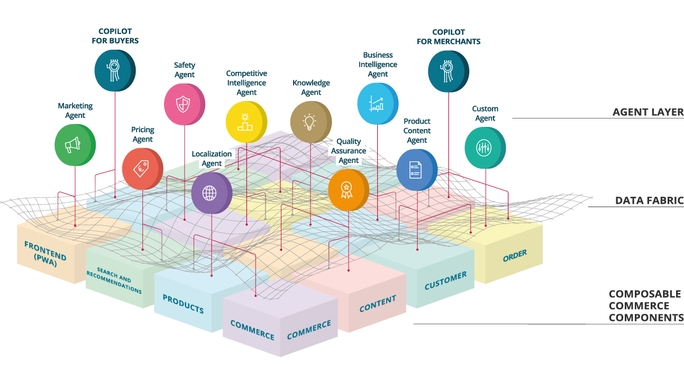
Unlike traditional automation which follows rigid, rule-based instructions, agents operate contextually and learn from experience. They continuously assess the current state of processes, recognize patterns, and adapt their actions accordingly. This is enabled by advanced AI technologies such as large language models, vector search, and semantic analysis. Agents are tightly integrated within the existing system landscape and communicate with third-party systems via APIs and other emerging standards like the model context protocol (MCP).
A key aspect of agentic commerce is the degree of autonomy. In many scenarios, agents begin as assistive systems, generating recommendations or preparing actionable insights for employees who make the final decisions. The real innovation emerges when agents are trusted to take responsibility for initiating processes, such as placing orders, launching price promotions, or conducting quality checks. This shift transforms agents into active participants in the commerce architecture, resulting in a true paradigm change and paving the way for autonomous commerce.
Agents don’t operate in isolation. They’re embedded within a broader commerce ecosystem, able to share information, collaborate, and delegate tasks among themselves. The transition from traditional systems to an agent-based ecosystem is gradual, not disruptive. Existing commerce platforms are enhanced with specialized agents that address specific challenges and deliver measurable value, allowing organizations to evolve their capabilities step by step, without risking business continuity.
Use cases for agentic commerce
Agentic commerce is no longer just a theory. Today, enterprises are already using AI agents to automate, optimize, and elevate core business processes in commerce. Especially in B2B e-commerce, where processes are complex and customer requirements are highly specific, agent-based solutions unlock new levels of efficiency and service. Many of these innovations are also applicable to wholesale and retail.
1. Sales support in B2B commerce
Digital sales agents analyze customer behavior, order histories, and assortment structures. Based on this data, they automatically generate tailored quotes, identify cross- and upselling opportunities, and adjust offers in real time to reflect market and customer data. In advanced scenarios, these agents communicate directly with customers. One example is the "Copilot for Buyers", an AI-powered sales assistant already in use with Intershop clients, delivering measurable improvements in conversion rates.
2. Intelligent customer consultation and service support
Service agents assist buyers in product selection, answer inquiries, and generate personalized order suggestions. They can provide technical details or recommend compatible alternatives 24/7 and tailored to each customer context. The "Copilot for Buyers" acts as a digital purchasing advisor during the buying process, significantly enhancing the customer experience.
3. Optimization and maintenance of product content
For companies with large catalogs and complex data, product data quality is crucial. Product content agents detect missing, outdated, or non-compliant information, analyze existing data, and automatically generate new, multilingual product descriptions as needed. They also consider SEO requirements and customer-specific needs. Editorial teams are relieved and receive automated, quality-assured content suggestions, significantly reducing the burden of repetitive tasks and freeing them up for more strategic work. The Intershop "Product Content Agent" is already used by wholesalers to ensure high data quality and up-to-date assortments.
4. Quality assurance in data and processes
Quality assurance agents continuously monitor the consistency and functionality of digital systems. They conduct automated checks, detect missing or incorrect data, and report issues to responsible teams. In advanced scenarios, they simulate user behavior, test workflows after updates, and document deviations, making a vital contribution to process reliability and compliance.
5. Automated procurement and replenishment
Procurement agents automatically identify reorder needs based on inventory data, sales figures, and lead times. They generate purchase suggestions, or, with the right approvals, trigger orders autonomously. In complex B2B environments, they also factor in supplier requirements, quantity tiers, and contractual conditions. This reduces manual work for procurement teams and ensures supply chain continuity.
Conclusion:
These practical examples demonstrate show that agents are far more than just a technological add-on. They take on real process responsibility, boost efficiency, and lay the foundation for new business models. Companies can start with clearly defined, manageable use cases and gradually expand their agentic commerce initiatives in a pragmatic way to evolve existing systems and unlock new business potential. As AI continues to transform the way businesses operate, agentic commerce is just one example of how intelligent solutions are reshaping the B2B landscape. Learn more about how artificial intelligence is already driving innovation and efficiency in B2B e-commerce today.
Key technologies in agentic commerce
Agentic commerce relies on a combination of modern technologies and specialized tools that give digital agents a solid basis to operate effectively in complex business environments and integrate with existing e-commerce stacks. The right mix doesn’t just lay the foundation for agentic capabilities – they set the organization up for more flexibility, scalability, security, and long-term competitiveness in B2B commerce.
API-first architecture:
Provides structured “docking-on points” so agents can integrate flexibly with existing commerce platforms, ERP, CRM, PIM, and third-party systems. Well-designed APIs allow real-time data exchange, modular expansion, and smooth interoperability.
Microservices:
Modular, independently deployable services provide the foundation for scalable and, resilient agent-based solutions. Microservices give development teams the freedom to do incremental rollouts, faster updates, and easier maintenance without disrupting core operations.
Artificial intelligence & machine learning:
The core intelligence of agentic commerce comes from AI models including large language models (LLMs), vector search, natural language understanding, and semantic analysis. These allow agents to process unstructured data, understand context, and make adaptive, autonomous decisions.
Automation engines:
Workflow automation and orchestration tools coordinate agent activities, manage process dependencies, trigger business logic, and maintain compliance across interconnected systems. Examples include platforms like n8n, Flowise, or Microsoft’s Power Automate, which allow businesses to design, automate, and monitor complex workflows that connect multiple agents and services.
Data integration & quality tools:
ETL pipelines, master data management (MDM), validation, and enrichment tools keep data clean, complete, and up-to-date so that agents are using relevant and timely information across all channels and touchpoints.
Security, compliance & trust frameworks:
Robust identity management, encryption, access control, and auditing frameworks are essential to protecting data, ensuring compliance, and maintaining trust.
Event-driven architecture & real-time messaging:
Event streaming and message brokers (e.g., Kafka, RabbitMQ) let agents respond instantly to changes in inventory, pricing, or customer behavior, for proactive and real-time decision-making.
Observability & monitoring platforms:
Logging, tracing, and performance monitoring tools track agent activities, detect anomalies, and provide transparency for troubleshooting and continuous improvement.
Cloud-native infrastructure:
Containerization, Kubernetes orchestration, and elastic scaling provide the agility to deploy, run, and scale agent-based workloads efficiently across hybrid or multi-cloud environments.
FAQs
What is the difference between agentic commerce and traditional automation?
Traditional automation follows fixed rules and scripts. Agentic commerce agents act contextually, adapt to new information, and can take initiative within defined boundaries.
How quickly can agentic commerce be integrated into existing systems?
Thanks to API-first and microservices architectures, agents can be integrated step by step. This can often be done without disrupting core business operations.
Which processes are ideal for agentic commerce?
Common starting points include product data management, quotation creation, customer service, and procurement. These areas have a major impact on B2B commerce.
Which B2B industries benefit most from agentic commerce?
Manufacturers, wholesalers, and distributors with complex, high-volume operations gain the most from agentic commerce.
Can agentic commerce work with my existing e-commerce platform?
Yes. Most agent-based solutions are platform-agnostic and connect via APIs, so they can integrate with popular B2B commerce systems without replacing them. Intershop already has a rich set of prebuilt AI agents that can immediately connect with your commerce solution.
How do AI agents make decisions?
Agents use AI models such as large language models, vector search, and semantic analysis to understand context, evaluate data, and select the best course of action based on defined goals and rules.
How is control over AI agents maintained?
Companies maintain control through clear governance, approval workflows, and real-time monitoring of agents’ actions and decisions.
What about data security and compliance?
Agents need to operate within secure, governed environments that enforce data protection, access control, and regulatory compliance. This is particularly important in industries with strict legal requirements.
Will AI agents replace human jobs?
No. Agents are designed to handle repetitive, data-heavy tasks so human teams can focus on strategic, creative, and relationship-building work.

Ready to future-proof your B2B commerce?
Get in touch and explore how agentic commerce can revolutionize your e-commerce.
